Mentoring Benchmark Switzerland 2025/26
The Mentoring Benchmark Switzerland 2025/26 analyzes, based on 100 HR interviews, how Swiss companies strategically implement and structure mentoring, considering the challenges and trends shaping the future of talent development.

Article written by
Pauline Meyer

What 100 HR Leaders Reveal About the Future of Talent Development
Why are Swiss companies investing massively in mentoring right now, and why do many programs still reach their limits?
In recent months, we have spoken with 100 HR leaders from all over Switzerland.
Banks. Hospitals. IT companies. Industry. Administration.
What we have discovered shows clearly:
Mentoring is at a turning point.
You can find the full results in the Mentoring Benchmark Switzerland 2025/26.
Why we started this research
The trigger for this research was personal experiences with mentoring and the repeated observation that despite the great interest of employees, the offerings and actual impact of many programs do not reach the expected potential.
Data & Delimitation
Mentoring can take place informally or formally.
Informal mentoring arises spontaneously in everyday work life and is based on individual relationships.
Formal mentoring programs, on the other hand, are structured, time-defined, and institutionally anchored. They are guided by HR and are organizationally embedded.
The focus of our research is deliberately on formal mentoring programs, as these can be systematically managed and quantitatively analyzed.
Of the 100 companies surveyed, 46 had at least one formal mentoring program. A total of 54 existing programs were analyzed in depth.
This foundation allows for a differentiated view of the current mentoring landscape in Switzerland.
Who stands behind the 100 interviews
The companies surveyed come from various industries and size classes.
They include organizations from the health, financial sector, IT, industry, services, and administration fields.
Both medium-sized companies and international corporations with over 1000 employees are represented.
The following overview shows the distribution of the 100 companies by sector, company size, as well as national or international orientation.
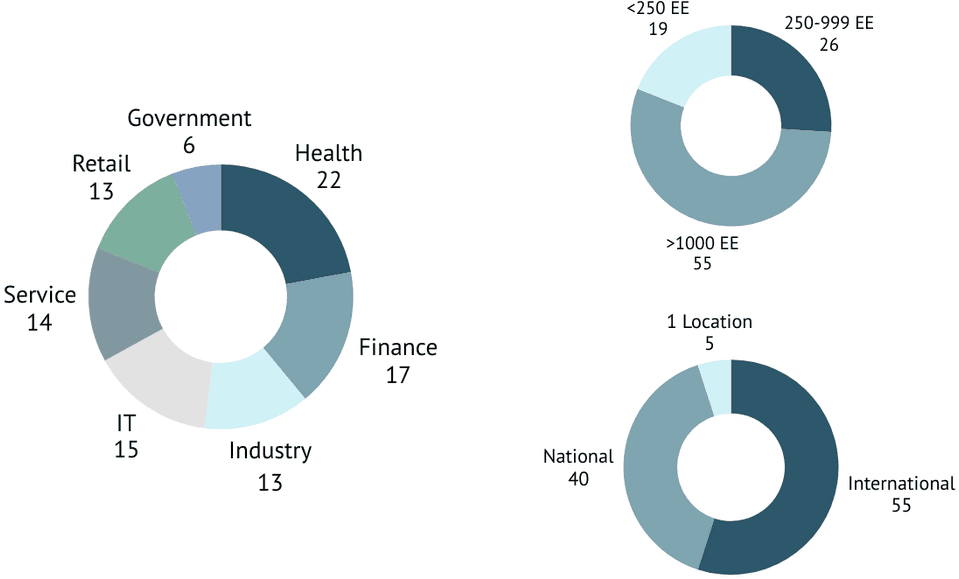
The image clarifies:
Mentoring is not a sector-specific topic. It is a cross-organizational development tool.
Mentoring in a phase of active implementation
A central result of our analysis is the dynamism of recent years.
Almost half of the mentoring programs examined were introduced since 2023.
This indicates that mentoring is increasingly being strategically anchored and is in a phase of active implementation.
This development raises a central question:
How do companies design mentoring so that it remains sustainable, effective, and scalable?
Detailed evaluations on objectives, matching approaches, best practices, and digitization can be found in the full report.
Article written by
Pauline Meyer